
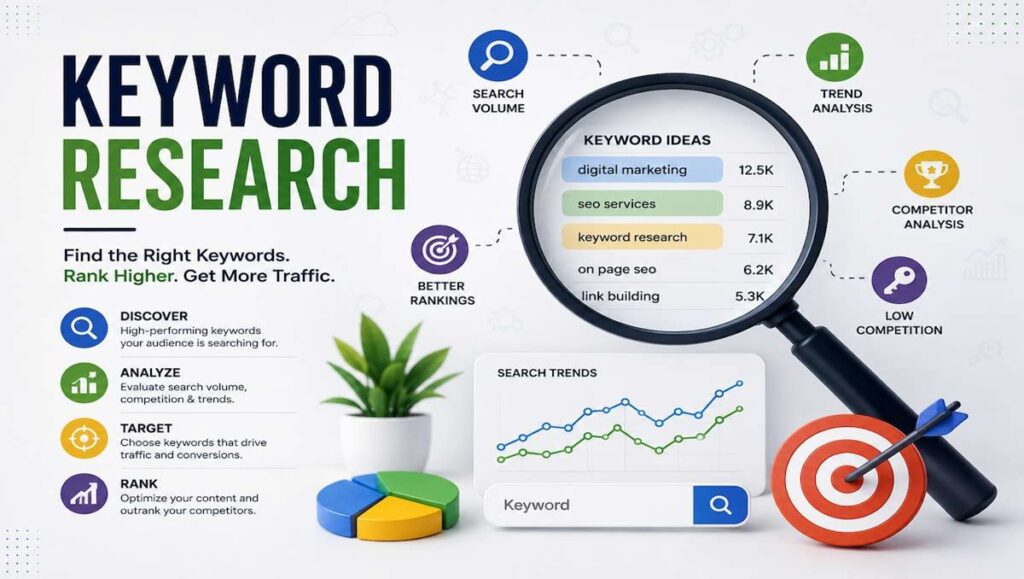
Find the Searches That Matter to Your Business
Keyword research helps identify the words and phrases potential customers use when searching for products, services, answers, and businesses online.
I research relevant search opportunities and organize them according to search intent, business relevance, competition, and the purpose of each page. The goal is to build a keyword strategy that supports useful content and sustainable organic traffic.
Start With Your Business
Effective keyword research should begin with understanding the business rather than simply collecting a large list of search terms.
I first consider:
- Your products or services
- Target customers
- Locations you serve
- Business objectives
- Target market
- Competitors
- Existing website structure
- Current organic visibility
This provides the context needed to identify searches that can actually support your business.
Discover Relevant Search Terms
I research different types of queries that may be relevant to your website, including:
Short-tail searches
Broad terms that can represent larger topics.
Long-tail searches
More specific queries that often provide clearer information about what the user wants.
Service-based searches
Queries related directly to the services your business provides.
Product searches
Terms people use when researching or looking for specific products.
Local searches
Queries containing locations or indicating local intent.
Informational searches
Questions and searches used to learn about a topic or solve a problem.
The exact mix depends on your business and target audience.
Understand Search Intent
A keyword is more useful when you understand why someone is searching for it.
I categorize search terms according to the likely intent behind them, such as:
- Informational
- Commercial
- Transactional
- Navigational
- Local
This helps determine whether a search term belongs on a service page, product page, category page, blog post, landing page, or another type of URL.
Competitor Keyword Research
Your competitors can reveal useful search opportunities that may not be obvious from your existing website.
I review competing websites to identify:
- Topics they target
- Search terms associated with their
- pages
- Content gaps
- Service opportunities
- Category opportunities
- Long-tail searches
- Areas where your website may have an opportunity to compete
The purpose is not to copy competitors, but to understand the search landscape and identify opportunities.
Keyword Clustering
Related search terms can often be grouped around the same topic instead of creating a separate page for every variation.
For example, several closely related searches may be better served by one comprehensive page rather than multiple pages competing with each other.
This approach can help create a clearer website structure and reduce unnecessary keyword overlap.
Keyword Mapping
After researching search terms, I map relevant groups to the most appropriate pages on your website.
A keyword map can help determine:
Homepage → Main business topic
Service page → Specific service
Product page → Specific product
Category page → Product or service category
Blog page → Informational topic
This helps give each important URL a clear search purpose.
Finding Content Opportunities
Keyword research can also reveal topics that your website does not currently cover.
These opportunities may include:
- Frequently searched questions
- Supporting topics
- Comparison searches
- Problem-based queries
- Buying guides
- Educational content
- Location-specific searches
The goal is to identify topics that are genuinely useful to your audience and relevant to your business.
Local Keyword Research
For businesses serving specific locations, I research terms that indicate local intent.
This can include combinations of services, products, and locations, as well as searches that imply the user is looking for a nearby business.
Local keyword research can support:
- Service-area pages
- Location pages
- Local landing pages
- Google Business Profile strategy
- Local content
I avoid creating unnecessary location pages simply to target every possible city
E-commerce Keyword Research
Online stores often need separate research for products, categories, brands, features, and buying-related searches.
I can research opportunities around:
- Product names
- Product types
- Categories
- Brands
- Features
- Specifications
- Comparisons
- Buyer-focused searches
The findings can then be mapped to product, category, and supporting content pages.
Keyword Research for Different Markets
I have worked on projects targeting markets including the United States, United Kingdom, Canada, Australia, and India.
Search behavior can vary between countries and audiences, so I consider the target market when researching search terms rather than assuming that the same keyword strategy works everywhere.
Keyword Research for Different Business Sizes
I work with small businesses, startups, growing companies, and established websites.
A small local business may need a focused set of service and location terms, while a large website may require a much broader keyword structure covering hundreds or thousands of topics.
The research process is adjusted according to the size and requirements of the website.
My Research Process
Business Understanding
I start by understanding your business, customers, services, products, and target market.
Search Discovery
I identify relevant search terms and related topics that may be valuable to your audience.
Intent Analysis
I evaluate what users are likely trying to accomplish with each search.
Competition Review
I examine the search landscape and competing pages to understand the level of opportunity.
Keyword Grouping
Related searches are organized into meaningful topic groups.
Page Mapping
I assign appropriate keyword groups to existing or planned pages.
Final Strategy
The research is turned into a practical keyword plan that can guide your content and SEO work.
What You Receive
Depending on the project scope, your keyword research may include:
- Primary keyword recommendations
- Secondary search terms
- Long-tail opportunities
- Search intent classification
- Competitor keyword insights
- Keyword clusters
- Keyword-to-page mapping
- Content topic ideas
- Local search opportunities
- E-commerce search opportunities
Why Quality Matters More Than a Large Keyword List
A spreadsheet containing thousands of keywords does not automatically create a strong SEO strategy.
The more important questions are:
Is the search relevant to the business?
Does the website have the right page for it?
Does the page satisfy the search intent?
Is there a realistic opportunity to compete?
I focus on answering these questions rather than simply producing a large list of search terms.
Keeping the Strategy Current
Search behavior changes over time as businesses, products, competitors, and search systems evolve.
I review keyword strategies when there are meaningful changes in your market, website, services, products, or search environment so that the targeting remains relevant.